Starknet Weighs Leaving Ethereum to Become a Quantum-Resistant L1: What It Really Means
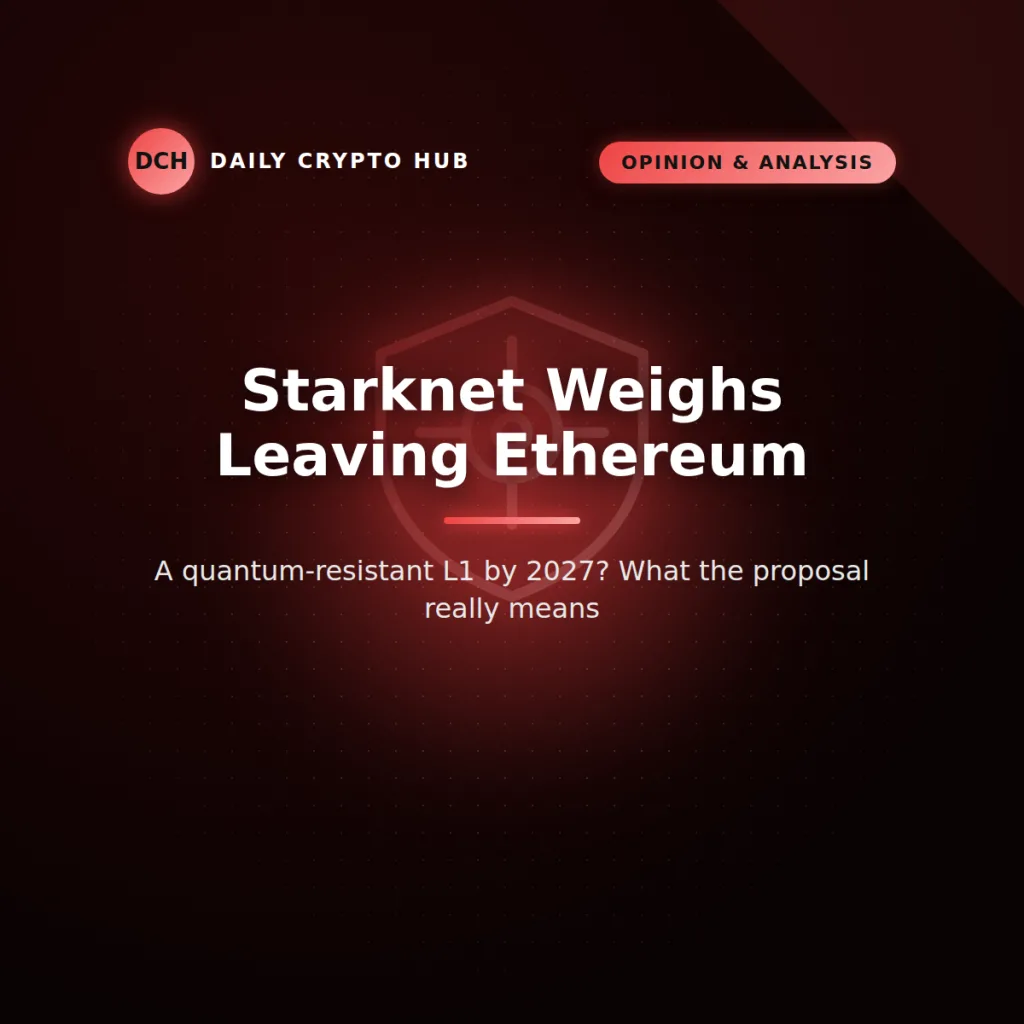
Starknet, one of the best-known Ethereum layer-2 networks, said this week that it is “actively considering” becoming an independent layer-1 blockchain, with the stated goal of becoming the first fully quantum-resistant network by 2027. The idea, floated in posts on X on October 8 by Starknet and StarkWare CEO Eli Ben-Sasson, sent the STRK token sharply higher. It also raises a bigger question that goes beyond one network: how much should quantum risk shape blockchain architecture today?
What Starknet actually announced
It is important to be precise about the status here. According to reporting from Unchained and The Crypto Times, this is a consideration, not a decision. No formal governance proposal has been published, no timeline for a governance vote was given, and Starknet’s own roadmap notes that protocol changes require approval through its governance process. The 2027 date is a target, not a guarantee.
Ben-Sasson framed the case around three requirements for future-proofing a network: appropriate cryptography, crypto agility (the ability to swap out cryptographic primitives as needed), and layer-1 status. He cited quantum computing and advancing AI capabilities as the twin pressures behind the idea.
The proposal builds on a quantum roadmap StarkWare laid out on June 30. That plan described three phases: replacing Pedersen hashing with BLAKE2, migrating existing contracts, and then addressing the network’s remaining dependencies on Ethereum, namely its bridge and its use of Ethereum blobs for data availability. Separately, Starknet has worked with OpenZeppelin on experimental Falcon-512 post-quantum signature accounts, which The Crypto Times notes remain unaudited.
The market reaction
STRK jumped about 40% in 24 hours to around $0.068 on October 9, according to The Crypto Times, with trading volume of roughly $412 million against a market cap of around $507 million. Even after that move, the token was about 98.5% below its all-time high of $4.41. A volume-to-market-cap ratio that high, alongside sizable perpetual futures open interest, suggests a lot of short-term trading rather than a settled reassessment of the project’s value.
Analysis: why the L1 angle is the interesting part
Starknet arguably starts from a better place than many networks on quantum resistance. STARK proofs rely on hash functions rather than the elliptic-curve assumptions behind ECDSA signatures, which are the main target of concern for a future large-scale quantum computer. That gives the team a credible technical story.
The harder part is the one the roadmap itself identifies: as long as Starknet settles to Ethereum and relies on Ethereum for data availability, its security is partly inherited from a chain that uses ECDSA for user signatures. Ethereum has its own post-quantum work underway, with a target that reporting places around the end of 2029. Starknet’s argument is essentially that it cannot be fully quantum-resistant on its own timeline while depending on Ethereum’s. Becoming an L1 removes that dependency, but at a real cost.
Being an Ethereum layer-2 is not just a technical arrangement. It is a large part of how rollups market their security, attract liquidity through bridges and plug into Ethereum’s developer ecosystem. Leaving that umbrella would mean Starknet needs its own validator set and its own economic security, and it would need to convince users and builders that the trade-off is worth it. For a token trading at a small fraction of its peak, that is a meaningful bet.
A broader trend worth watching
Starknet’s move fits a pattern we have been tracking. Earlier this week we looked at Justin Drake’s ‘bunker mode’ warning about AI risk to wallet cryptography, and the theme is the same: post-quantum and AI-driven security concerns are moving from academic papers into explicit roadmap goals. Networks are increasingly competing on how prepared they are, not only on speed and fees.
The sensible reading is that quantum risk deserves serious engineering attention without justifying panic. No one knows exactly when a cryptographically relevant quantum computer will arrive, and the timelines quoted by project leaders are partly marketing. What matters for users is whether networks build in the ability to upgrade cryptography smoothly, which is exactly what “crypto agility” means.
What to watch next
- Whether a formal governance proposal is published, and what it says about validators, the bridge and data availability.
- Audits of the Falcon-512 account work and progress on the BLAKE2 migration.
- How Ethereum researchers and other rollup teams respond, since a high-profile L2 leaving would be a notable moment for the rollup-centric roadmap.
For now, Starknet has started a conversation more than it has changed anything. That conversation is worth following, but holders should treat the 2027 target as an ambition still subject to governance and engineering realities.
This article is analysis and commentary for informational purposes only and does not constitute financial advice.