Ripple Wins Final OCC Approval for Its National Trust Bank: What It Means for RLUSD Holders
Disclosure: This article contains affiliate links. As an Amazon Associate, Daily Crypto Hub earns from qualifying purchases at no extra cost to you.
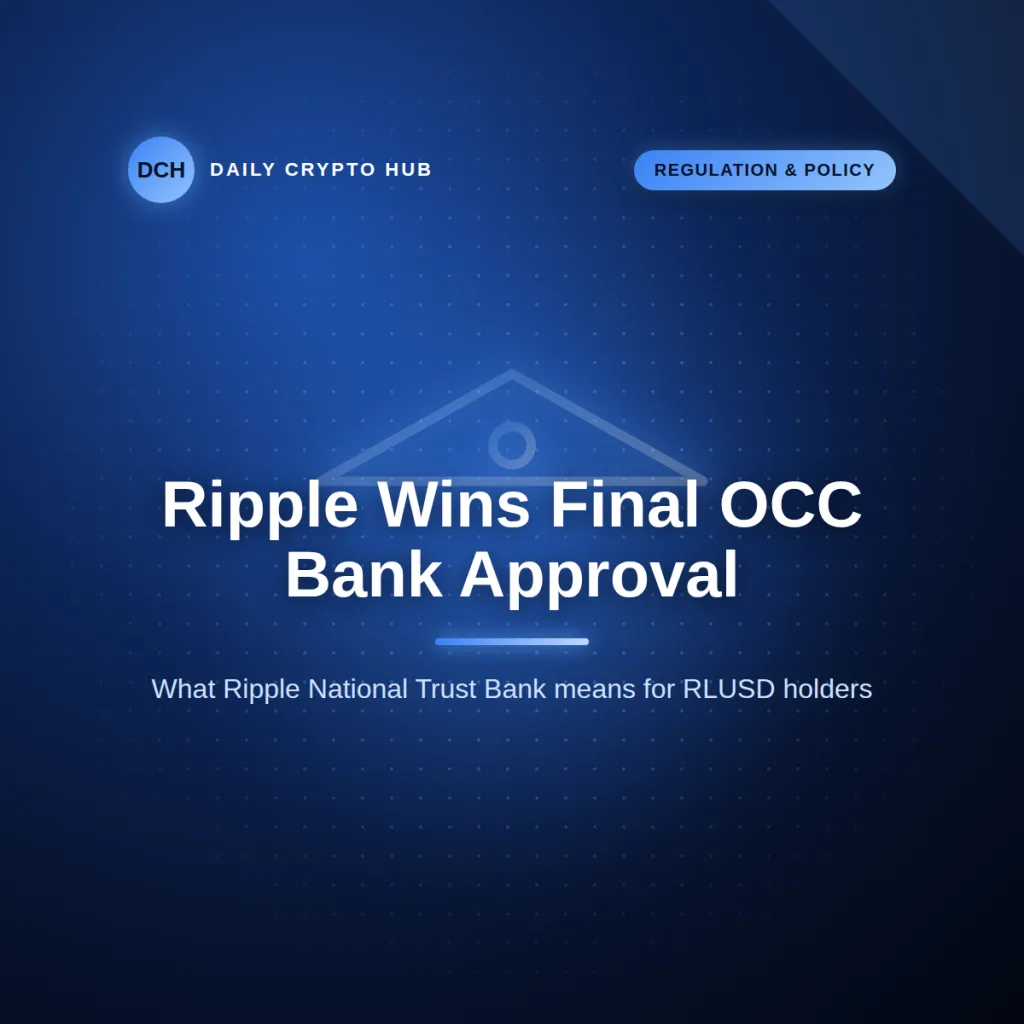
Ripple has cleared the last federal hurdle for its own bank. On Monday, October 26, 2026, the company announced that the Office of the Comptroller of the Currency (OCC) granted final approval for Ripple National Trust Bank (RNTB), a federally supervised national trust bank based in New York. The decision comes roughly ten months after the OCC gave Ripple conditional approval in December 2025, in the same round that included Circle, Paxos, Fidelity Digital Assets and BitGo.
The headline sounds bigger than “a new bank,” and also smaller. RNTB will not take deposits, make loans or issue stablecoins. What it will do is sit at the center of how Ripple’s dollar stablecoin, RLUSD, is backed and safeguarded. Below we break down exactly what the charter allows, why it matters for RLUSD holders, the lawsuit that could still complicate things, and what to watch next.
What the OCC Actually Approved
A national trust bank is a narrow kind of bank. It operates under a federal charter and OCC supervision, but its business is fiduciary: holding and managing assets on behalf of others. According to Ripple’s announcement as reported by Ledger Insights and Decrypt, RNTB will be permitted to:
- Manage the segregated reserve assets that back RLUSD, on a directed basis.
- Act as collateral trustee for RLUSD holders, in a fiduciary capacity.
- Provide fiduciary digital asset custody to Ripple affiliates and outside institutional clients.
Just as important is what does not change. RLUSD will continue to be issued by Standard Custody & Trust Company (SCTC), Ripple’s existing subsidiary regulated by the New York State Department of Financial Services (NYDFS). Ripple says RNTB does not plan to issue stablecoins. BNY remains the primary custodian for RLUSD’s reserves, as it has been since Ripple named the bank to that role in July 2025.
The practical result is a layered structure: a state-regulated issuer, a federally supervised trust bank overseeing reserves and acting as trustee for holders, and a large traditional custodian holding the underlying assets. Decrypt described the outcome as RLUSD being supervised at both the state and federal levels.
Background: How RLUSD Got Here
RLUSD launched in December 2024 as Ripple’s U.S. dollar stablecoin. Its market capitalization is about $2.6 billion according to CoinGecko data cited by Decrypt. That makes it a meaningful but still mid-sized player next to the largest dollar stablecoins. Ripple uses RLUSD across its payments network and as collateral within Ripple Prime, its brokerage arm, and it has been piloting trade finance use cases, including a Singapore sandbox project with Unloq that combined RLUSD with the XRP Ledger.
Alongside the charter news, Ripple also announced expanded RLUSD partnerships with BNY and Robinhood, which it framed as extending the stablecoin’s reach across institutional custody, trade finance and retail trading. Ripple has not published detailed terms of the Robinhood arrangement in the reporting we reviewed, so treat any specific claims you see on social media about how or when RLUSD will appear in the Robinhood app with caution until the companies confirm them.
Why This Fits the GENIUS Act Era
The timing is not accidental. Just days earlier, the OCC finalized its rule implementing the GENIUS Act, the federal stablecoin law, which we broke down in our explainer on what the OCC’s GENIUS Act rules change for holders. Ripple said it will keep working with the OCC, NYDFS and other regulators as RNTB begins operations and as the GENIUS framework is rolled out.
Ripple is also not alone. Circle received its own final OCC approval in July 2026, and BitGo obtained its green light in December 2025. According to the community bankers’ lawsuit described below, the OCC has approved or conditionally approved 21 trust bank charters under the current administration, with at least 13 tied to digital asset firms. In other words, federal trust charters are quickly becoming the standard credential for serious stablecoin and custody businesses in the U.S.
Europe is moving in a parallel direction with different tools. As we covered when ESMA gave EU crypto firms until January 8, 2027 to drop non-MiCA stablecoins, regulators on both sides of the Atlantic are pushing stablecoins toward clearly supervised issuers and reserve arrangements.
The Lawsuit Hanging Over Crypto Bank Charters
Not everyone is happy about this wave of approvals. On October 2, the Independent Community Bankers of America (ICBA) sued the OCC in federal court in Washington, D.C. The group is seeking to void the March 2026 rule and interpretive letter that underpin these charters, arguing that the OCC exceeded its statutory authority. The ICBA’s core complaint is that the charters give crypto firms the credibility of a federal bank without the capital requirements, consolidated supervision and FDIC insurance obligations that community banks face.
Political pressure is coming from Capitol Hill too. Sen. Elizabeth Warren wrote to Comptroller Jonathan Gould arguing that the approvals for Coinbase and Ripple violated the National Bank Act. On the other side, the Digital Chamber, a crypto industry trade group, urged the OCC to defend the charter approvals.
None of this undoes Ripple’s approval today. But it means the legal footing for crypto trust charters is not fully settled, and a court ruling against the OCC could force changes to how these institutions operate.
What This Means for You
If you hold RLUSD: The main change is oversight. A federally supervised trust bank acting as collateral trustee and managing segregated reserves adds a layer of accountability on top of the existing NYDFS regime. That does not make RLUSD risk-free, and it is important to understand that a trust bank charter is not FDIC deposit insurance. Your stablecoin is still a claim backed by reserves, not an insured bank deposit.
If you hold XRP: The market reaction was muted. Decrypt reported XRP up about 0.5% over 24 hours to roughly $1.29 on the day of its coverage. The charter is about RLUSD’s infrastructure, not a direct change to how XRP works, so be skeptical of anyone claiming the news guarantees a price move.
If you are an everyday crypto user: Stablecoins are steadily being pulled into the regulated banking perimeter. Over time that may mean more mainstream apps offering regulated stablecoins, and clearer rules about who holds the reserves. It also means the “who holds my assets?” question matters more than ever. If you are not sure whether your coins belong on an exchange, in a hot wallet or in cold storage, run through our free Exchange vs Hot Wallet vs Cold Wallet checker.
A Quick Checklist for Stablecoin Holders
- Know your issuer. For RLUSD, the issuer remains Standard Custody & Trust Company, not RNTB. Check who issues any stablecoin you hold and who regulates them.
- Read the reserve disclosures. Regulated issuers publish reserve attestations. Look at what the reserves are made of and who holds them.
- Don’t confuse “bank charter” with “insured deposit.” Trust banks hold assets in a fiduciary capacity; that is different from FDIC-insured savings.
- Verify token contract addresses. High-profile news reliably brings out fake tokens and impostor “airdrops.” Only use contract addresses published on the issuer’s official site.
- Watch for phishing. Scammers love to piggyback on headlines. Our guide to staying safe from crypto phishing after a data breach covers the warning signs.
- Self-custody what you don’t need on a platform. If you hold stablecoins or other assets long term, consider whether a hardware wallet makes sense for your situation.
What to Watch Next
- RNTB’s launch timeline. Final approval allows the bank to begin operations; watch for Ripple to confirm when RNTB formally takes over reserve management and trustee duties.
- The ICBA lawsuit. Any ruling on whether the OCC’s March 2026 rule stands could affect every crypto trust charter, not just Ripple’s.
- Robinhood and BNY details. Concrete terms on how RLUSD will be offered to retail users through Robinhood would be the clearest signal of how far this reaches beyond institutions.
- GENIUS Act implementation. More final rules from federal regulators will shape how all U.S. stablecoins are issued, backed and audited.
- Congress after the midterms. With the CLARITY market-structure bill stalled in the Senate, the lame-duck session after the November elections is the next window for broader crypto legislation.
Frequently Asked Questions
What is Ripple National Trust Bank?
Ripple National Trust Bank (RNTB) is a New York-based national trust bank that received final OCC approval on October 26, 2026. It will manage RLUSD’s segregated reserves, act as collateral trustee for RLUSD holders and offer fiduciary digital asset custody to institutional clients.
Does Ripple’s trust bank issue RLUSD?
No. RLUSD will continue to be issued by Standard Custody & Trust Company, Ripple’s NYDFS-regulated subsidiary. Ripple says RNTB does not plan to issue stablecoins.
Is RLUSD FDIC insured now?
No. A national trust bank charter means federal supervision of fiduciary activities, not FDIC deposit insurance. RNTB cannot take deposits or make loans, and RLUSD remains a reserve-backed stablecoin.
Which other crypto companies have OCC trust charters?
Circle received final OCC approval in July 2026 and BitGo received its approval in December 2025. Paxos and Fidelity Digital Assets were among the firms conditionally approved alongside Ripple in December 2025.
Why are community banks suing the OCC?
The Independent Community Bankers of America argues the OCC exceeded its authority and that the charters let crypto firms gain the credibility of a federal bank without facing the capital rules, consolidated supervision and FDIC requirements traditional banks do.
Read More and Protect Your Crypto
If this story has you thinking about how stablecoins, banking and custody fit together, these picks are genuinely relevant:
- The Bitcoin Standard by Saifedean Ammous – a widely read primer on money and banking history that gives useful context for why stablecoins and bank charters are colliding. Check current price on Amazon
- The Infinite Machine by Camila Russo – the story of how Ethereum was built, the network where much of today’s stablecoin activity takes place. Check current price on Amazon
- Ledger Nano X hardware wallet – if you hold stablecoins or XRP long term, a hardware wallet keeps keys offline instead of trusting a platform. Check current price on Amazon
- Cryptosteel Capsule seed phrase backup – a metal backup for your recovery phrase, so self-custody does not hinge on a piece of paper. Check current price on Amazon
This article is for informational purposes only and does not constitute financial advice.