
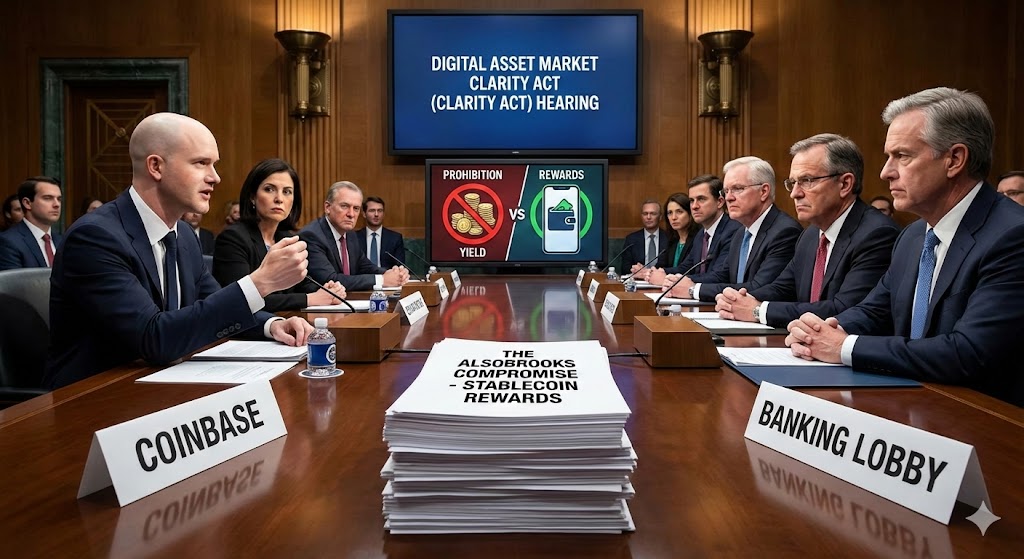
As the U.S. Senate prepares for a high-stakes markup session on January 15, 2026, the long-awaited Digital Asset Market Clarity Act (CLARITY Act) is facing a sudden and potentially fatal hurdle. Coinbase, the largest U.S. cryptocurrency exchange, has signaled it may withdraw its support for the bill—a move that could derail years of bipartisan progress toward federal crypto regulation.
The core of the dispute isn’t the bill’s main goal of dividing oversight between the SEC and CFTC, but rather a contentious provision regarding stablecoin rewards.
The “Red Line”: Stablecoin Rewards vs. Banking Interest
The friction stems from the GENIUS Act, which was signed into law in July 2025 to regulate stablecoins. That law explicitly prohibits stablecoin issuers from paying interest to holders to prevent them from functioning like unregulated banks.
However, the banking lobby is now pushing to extend this prohibition to exchanges like Coinbase. They argue that the “rewards” Coinbase offers users for holding USDC are simply “interest by another name,” which could lead to a massive flight of deposits from traditional community banks to digital wallets.
Coinbase’s Stance: Coinbase CEO Brian Armstrong has labeled this issue a “red line.” In recent statements, Coinbase leadership has argued that:
-
Consumer Benefit: Yield-like rewards are a primary reason users choose stablecoins over traditional cash.
-
National Competitiveness: Coinbase executives, including Chief Policy Officer Faryar Shirzad, have warned that banning these rewards would hand a competitive advantage to China’s digital yuan, which does offer yield to its users.
-
Regulatory Overreach: They claim the banking lobby is attempting to stifle innovation to protect its own dwindling deposit bases.
The “Alsobrooks Compromise”
In an attempt to save the bill, Senator Angela Alsobrooks (D-Md.) proposed a middle-ground solution:
The Proposal: Exchanges could pay rewards on stablecoins used in “active transactions,” but not on “idle balances” sitting in a user’s account.
The response from Coinbase was swift and dismissive. Chief Legal Officer Paul Grewal criticized the plan on social media, questioning how it benefits consumers to penalize them for holding a balance. This rejection suggests that Coinbase is prepared to “tank the bill” rather than accept a framework that limits its ability to offer competitive financial products.
What’s at Stake?
The CLARITY Act is considered the most significant piece of crypto legislation in U.S. history. It provides the legal “rules of the road” that institutional investors have demanded for years. If Coinbase and its advocacy group, Stand with Crypto, withdraw their support, the bill loses its primary industry champion.
White House crypto advisor Patrick Witt issued a stark warning to the industry this week:
“For those threatening to withhold support… I would remind you that tanking the bill over this issue preserves the status quo which you allege is intolerable.”
Potential Outcomes:
{table id=5}
Next Steps
All eyes are on the Senate Banking Committee hearing scheduled for January 15, 2026. This session will likely determine if the bill moves to a full floor vote or is sent back to the drawing board.
