
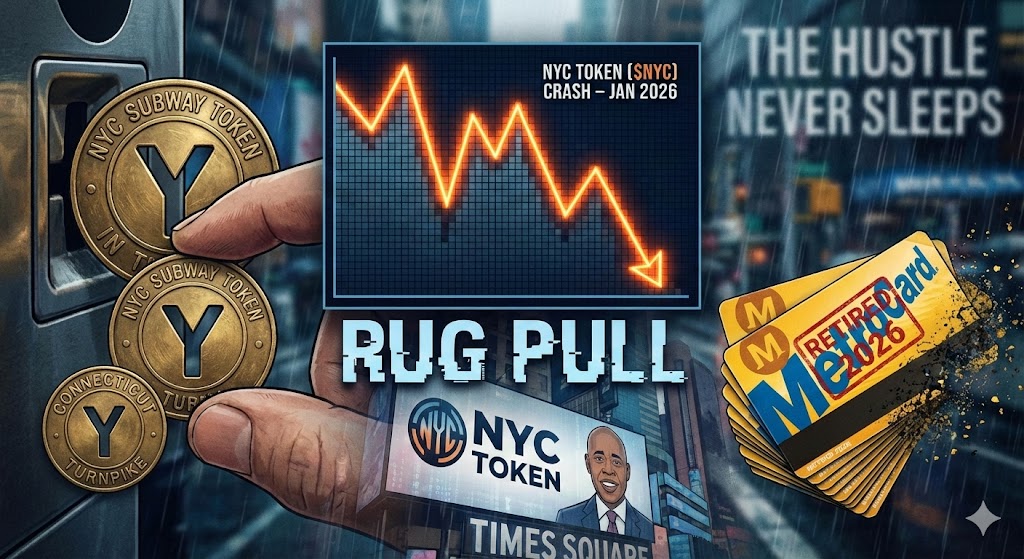
The NYC Token Scam: From Subway Slugs to Digital Rug Pulls
In the city that never sleeps, the “hustle” is legendary—but so is the scam. In early 2026, a new chapter was written in New York’s long history of grift when the NYC Token ($NYC), a high-profile cryptocurrency, collapsed in what many are calling a classic “rug pull.”
While the technology has changed, the core of the NYC token scam remains the same: exploiting the city’s iconic status to lure in unsuspecting investors.
The 2026 Crypto Crash: The Eric Adams “NYC Token”
On January 12, 2026, former Mayor Eric Adams—long known as the “Bitcoin Mayor”—launched the NYC Token at a flashy press conference in Times Square. The coin was marketed as a “community-driven” asset designed to fund scholarships and combat antisemitism.
The results were immediate and devastating:
-
The Surge: Within hours of its debut on the Solana blockchain, $NYC skyrocketed to a market capitalization of $580 million.
-
The Crash: In less than thirty minutes, the value plummeted over 81%.
-
The Allegation: Blockchain analysts, including the platform Bubblemaps, flagged suspicious “liquidity movements.” A wallet connected to the token’s deployer reportedly removed approximately $2.5 million at the peak, leaving retail investors with worthless digital assets.
While the project’s official X account claimed they were simply “rebalancing liquidity,” critics and investors have labeled it a textbook rug pull—a scam where developers hype a project, wait for the price to peak, and then drain the liquidity pool to disappear with the funds.
A History of NYC Token Grifts
The 2026 scandal is only the latest evolution of the “NYC token scam.” For decades, scammers targeted the physical tokens used in the New York City subway system.
1. The “Token Sucking” Era
Before the MetroCard was introduced in 1993, NYC transit was powered by small brass tokens. A common scam involved “stuffing” the token slot with paper or gum so that a passenger’s token would get stuck. After the frustrated rider walked away, the “token sucker” would literally put their mouth to the slot and suck the token out.
Note: This became such a nuisance that token booth attendants reportedly began sprinkling chili powder into the slots to deter the practice.
2. The Great Connecticut Token War
In the early 1980s, New Yorkers discovered that Connecticut Turnpike toll tokens were the exact same size and weight as NYC subway tokens. Since Connecticut tokens cost only 17.5 cents compared to the NYC fare of 60 cents, thousands of people used them as “slugs” to ride the subway at a deep discount. It took years of legal battles and a change in token design to end the “war.”
The 2026 MetroCard Retirement Scams
As New York officially retired the MetroCard in favor of OMNY on January 1, 2026, a new niche scam emerged. Collectors and tourists began seeing “rare” or “final edition” MetroCards on eBay for as much as $10,000.
-
The Trick: Scammers list standard-issue yellow MetroCards as “vintage memorabilia.”
-
The Reality: These cards are essentially plastic trash, and while they can be used until June 2026, they hold no intrinsic value above the $3.00 fare.
How to Protect Yourself
Whether it’s a “commemorative” subway token or a new “official” city cryptocurrency, scammers always use urgency and authority to bait their hook.
| Red Flag | What to Look For |
|---|---|
| Celebrity Endorsements | Many "city tokens" use political figures to gain unearned trust. |
| High Concentration | If a few digital wallets hold 90% of a token's supply, a rug pull is likely. |
| Scarcity Tactics | Claims that a "legacy" item like a MetroCard is worth thousands of dollars. |
The NYC Token scam of 2026 serves as a stark reminder: in the digital age, if an investment sounds like it’s too good to be true, it probably belongs in the same category as a “bridge in Brooklyn” for sale.
